



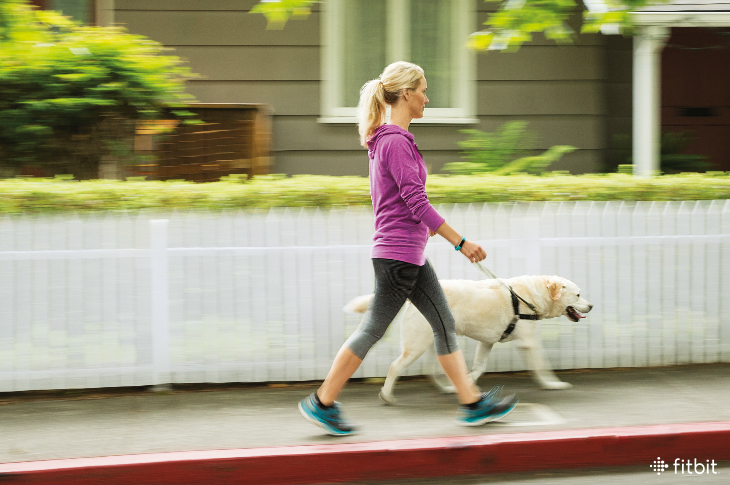

As a Fitbit Native ambassador and the proprietor of Stronghorn Health, Martin is aware of properly the advantages of canine strolling, each for furry associates and their homeowners. Canine homeowners who recurrently stroll their pets train a mean of twenty-two minutes extra per week than non-dog homeowners. And but, 40 p.c of canine homeowners aren’t strolling their canine companions, partly as a result of they imagine the canine is simply too outdated, too sick, or too fats.
The issue is that many individuals don’t think about strolling the canine to be a very good exercise. However, says Martin, nothing may very well be farther from the reality. “The well being advantages of simply happening a stroll are numerous,” says Martin. “And in the event you go on that stroll with intention, it not solely turns your stroll right into a exercise, it additionally turns into a bonding expertise together with your fur child.”
The important thing, says Martin, is to keep away from strolling round aimlessly. “Put guidelines in place so that each block you stroll or each nook you flip, you do one thing,” says Martin. His total-body, dog-walking routine under will assist you to get began.
Learn how to Squeeze in a Whole-Physique Exercise Whereas Strolling Your Canine
Heat-up:
“Canine and people must get the blood flowing earlier than they transfer into extra vigorous train,” says Martin. So for the primary block or two simply consider regularly ramping as much as a brisk tempo. “Most pups can transfer fairly quick, no matter measurement,” says Martin. “But when your fur child is struggling to maintain up, make the warm-up stroll slower, however longer. Utilizing your Fitbit gadget, intention to get your coronary heart fee into the fat-burning zone (50 to 69 p.c of your max). Should you’re not utilizing a tool with heart-rate monitoring, let the “speak take a look at” be your information—you need to have the ability to maintain a dialog whereas strolling, however not sing.
At every nook (or each two blocks):
Do 10 squats or 10 standing push-ups in opposition to a steady construction, equivalent to a fence, holding your actions gradual and managed and sustaining a agency grip on the leash.
Squats: Stand together with your toes shoulder-width aside and your arms straight out in entrance of you. Protecting your knees in step with your toes and your hips again, decrease your self as in the event you had been going to sit down in a chair. When your thighs are parallel with the bottom, pause, then slowly get up.
Fence push-ups: Dealing with a fence, stand about an arm’s size away together with your palms flat in opposition to the fence, shoulder-width aside. Protecting your toes flat on the bottom, bend your elbows and slowly lean into the fence. When your elbows are at a 90-degree angle, pause, then push again till your arms are straight.
Each time your pup stops to scent the bushes:
As an alternative of dashing her or him, use this time to do some squat holds, suggests Martin.
Squat maintain: Stand together with your toes shoulder-width aside. Protecting your knees in step with your toes and your hips again, decrease your self till your thighs are parallel with the bottom. Maintain there for 45 seconds to at least one minute minute. Make sure to hold your chest up, your shoulders again, and your core engaged.
Throughout potty breaks:
When your canine stops to do its enterprise, you are able to do some interval coaching within the type of alternating toe faucets on the curb.
Toe faucets: Stand dealing with the curb together with your proper toe on the curb and your left foot on the bottom. Utilizing a hopping movement, change positions, in order that your left toe is on the curb and your proper foot is on the bottom. Proceed rapidly alternating your toes for 30 seconds to a minute.
On the canine park:
On days you head to the canine park (both on foot or within the automotive), add in some cardio enjoyable. Throw a ball so far as you possibly can. Whereas your pup races to retrieve it, do some leap lunges—or common lunges if plyometric workouts aren’t within the playing cards. “The great thing about this train is that your canine is the timer,” says Martin. “The farther you throw the ball, the longer it’s going to take her or him to deliver it again.” Repeat 5 occasions.
Leap lunge: Protecting your again straight and your core engaged, step backward together with your left leg and decrease your hips till your knees are at a 90-degree angle. Pushing off the bottom, leap straight up, switching your legs in mid-air so that you simply land together with your proper leg again within the lunge place and your left leg ahead. Repeat, alternating legs, till your canine returns with the ball.
Common lunge: Protecting your again straight and your core engaged, step backward together with your left leg and decrease your hips (holding your entrance knee over your toes) till your knees are at a 90-degree angle. Slowly stand again up and repeat, switching legs. Proceed till your canine returns with the ball.


